A Family Chronicle
Before we were Jacowski, we were
Džačovský
One Slovak family from a small Šariš village in the shadow of the Carpathians — rye fields, beech woods, and the long road across an ocean that brought them here.
Section One
The Name
Start here, because everything else is a consequence of it. The surname we carry today — Jacowski — is not the name the family carried for most of its history. The name they carried was Džačovský, and the first time we can find it written down is the summer of 1756, when a Franciscan priest heard the family say it themselves and rendered its Slovak sound in Latin letters — Dzjacsovski.
The sound was always the same — something close to JAH-chov-skee, opening with the soft Dž- cluster (the j of judge) that Slovak speakers produce naturally but English speakers struggle with, and turning on a č in the middle — the consonant the 1756 register and the family’s own gravestones both preserve, two centuries apart. That č is the through-line of the name, not the hard k a Hungarian clerk would later give it. The spelling was what kept changing.
A Hungarian official in 1875 wrote Dzákovszky. A Slovak priest in Pennsylvania in 1894 wrote Djacovsky. A German clerk at the port of Hamburg in 1887 wrote Jacowsky. An American county registrar in Hazleton wrote Jacowski. All five men were writing the same name. None of them consulted the family. None of them agreed.
By the time the paperwork reached Wisconsin in 1915, the family had been Jacowski for a generation. The D was gone. The Slovak -ský had become the Polish -owski. The diacritics were gone. What remained was a tidy Polish-looking surname — for a Slovak family that had never been Polish — rooted in a Slovak village that had never been part of Poland.
“That’s how our name used to be spelled.”
Five spellings, one name
Each row is a different person writing the name down — four of them holding a pen, one of them reading someone else’s handwriting two centuries later. That last distinction matters more than it looks, and it is flagged where it applies.
- Dzjacsovski1756
Father Bonaventura, OFM Conv. · Šarišské Michaľany Latin register
The oldest known spelling. Written on the page as both Dzjacovsky and Dzjacsovski — the "cs" is a Latin rendering of the Slovak č. The D is authentic, and so is that middle č.
- Désacsovský1772–77
A FamilySearch indexer — not a clerk · Šarišské Michaľany register, as transcribed
This row needs a caveat the others do not. Désacsovský is a modern indexer's reading of the priest's Latin hand, not a spelling anyone wrote in the 1770s. The register itself reads closer to Dejacjowski and Dzejacjowski. It records how the name came to be read, not how it was written — and an argument built on it is built on a transcription.
- Dzákovszky1875
Hungarian state register · Sabinov (Kis-Szeben) R.C. parish
The Magyarized official form: a hard -k- and a Hungarian -szky tail. This is the spelling that once looked like the root — but it is the variant. The Hungarian clerk flattened the č to a k.
- Džačovskýmodern
The family itself · Gravestones, Sabinov R.C. cemetery
The canonical modern Slovak form, the č restored — read directly off the family's own gravestones in Sabinov. This is the spelling that corrected the record. Stripped of its diacritics, the way American and online records write it, it becomes plain Dzacovsky.
- Jacowski1893–now
American county clerks · Pennsylvania, Ohio, Illinois, Wisconsin
The settled American form. The D was dropped, the Slovak -ský became a Polish-looking -owski, and the diacritics vanished. Along the way — on the SS Werra manifest of 1887, the Luzerne County marriage docket of 1893, a Slovak priest's hand at St. Joseph's in 1894 — it passed through Jacowsky, Jakofski, and Djacovsky before it stuck.
So what was the name?
The honest answer is that it depends which register you mean — the paper one or the spoken one. They were never the same thing, and only one of them belonged to the family.
Formally, as written
Gyagyovszky · Dzsacsovszky · Dzákovszky
Whatever the clerk of the day used. Each one a convention, none of them chosen by the family.
As they’d have spoken it
Džačovský · Džačovská
The form on the stones. The one continuous thing across three centuries of other people’s spelling.
The spellings that open the archive
This turned out to be the most practical lesson in the whole project, and the one that broke the research open. The surname’s findable form in the Hungarian-era registers is a phonetic Hungarian spelling — and the familiar Dzákovszky, the one the family carried on paper, misses almost everything.
Two forms do the work. Dzsacsovszky surfaces Andrew’s own generation, the 1860s and 70s — it is what cracked open the Šarišské Michaľany baptism register and gave us his parents. Gyagyovszky — Hungarian Gy- standing in for the dž — reaches the layer beneath it, households back into the 1820s and burials into the 1700s. Andrew’s own brother, baptized 1861, was found only under the Gy- form.
The mapping, once you have it: Ds / Dzs / Gy → Dž · cs / gy → č · ovszky → ovský. Also worth searching: Dsacsovszky, the way the parish priest wrote it in the 1870 register, and Djacsovszky, Gyzaczovszky.
That Gy- does double duty. In Hungarian it spells a soft ď rather than a dž — so the family’s name was being written at both ends of one sound, and that turns out to decide an argument about where the name comes from, below.
Every spelling this surname has been found under
Posted in full for anyone searching for their own family. Each group names where the spelling comes from. A caution: the last two groups include Šariš households that are not this line — the surname is dense across the region, and a shared spelling is not kinship.
- Latin parish register, 1756 · Šarišské Michaľany
- Dzjacsovski · Dzjacovsky
- Liber Mortuorum, 1777 · p. 88
- Dzeacsovszky
- Register hand, 1772–77 — and the modern index of it
- Dejacjowski · Dzejacjowski (the page) · Désacsovský · Desacsovskÿ (the transcription)
- Hungarian-era registers — the searchable forms
- Gyagyovszky · Dzsacsovszky · Dsacsovszky · Djacsovszky · Gyzaczovszky · Dzákovszky
- Modern Slovak — the form on the gravestones
- Džačovský · Džačovská (feminine) · Dzacovsky (without diacritics)
- American records, 1887 onward
- Jacowsky · Jacowski · Jacovsky · Jakowsky · Jakofski · Dzacowski · Dzacovsky · Djacovsky
- Other Šariš and Spiš households — same surname, not this line
- Dzaczovszký (Zborov, 1877) · Dzakovszky (Žehra, 1794)
One, continued
Where the name comes from
An honest accounting
One structural fact does not depend on any single reading: the name is built as [root] + -ovský, a Slovak adjectival suffix meaning of, from, belonging to. Slovak surname references are consistent that -ovský names are overwhelmingly inhabitant-names formed from place names — which argues for a place origin and against a nickname. So: a place, probably. Which place is the hard part.
The name most likely means “the family from Ďačov” — a real village in Sabinov District, about fifteen kilometers from the family seat, first mentioned in 1338, Hungarian name Décső. A Džačovská serves in that municipality’s administration today.
The core argument: Diačžow ↔ Džačovský
The strongest single piece of the etymology is an alignment that is document-to-document and same-language — no transcriptions, no reconstructions, no crossing between Slovak and Hungarian to make the shapes fit.
The village · 1773
Diačžow
Historical name-record of Ďačov
The surname · modern
Džačovský
Carved on the family’s Sabinov gravestones
Both are real written spellings. The phonetic fit is close and specific: Diačž- and Džač- carry the same unusual affricate cluster, and no other era’s village spelling matches as well. The later forms — Diačow 1786, Dačow 1808, Ďačov 1920 — flatten toward a soft ď, and that flattening is what creates the modern ď-versus-dž mismatch. Going back to 1773 largely closes the gap.
The timing reinforces it, and this is a real argument rather than a feeling. Hereditary surnames among the Slovak and Hungarian peasantry hardened late — through the 1700s into the 1800s. The end of serfdom in the Habsburg lands, Joseph II’s patent of 1785 and full abolition in 1848, is exactly when peasant families needed fixed, legally stable surnames for land, tax, and conscription records — the very documents that pinned names down. A place-origin surname crystallizing in the late 1700s out of a village name then in use — Diačžow, 1773 — is chronologically coherent.
The village’s own spellings
Ďačov was written two ways for six centuries, a Hungarian stream and a Slovak one running side by side. The claim above rests on where the Slovak stream sat in 1773 — so here is the whole trail, to be checked rather than taken on trust.
HungarianDeychehalma 1338 → Décső 1773 → Decschj 1786 → Decső 1808 → Décső 1863–1913
SlovakDiačžow 1773 → Diačow 1786 → Dačow 1808 → Ďačov 1920–
The Gy- spelling closes the old objection
For a long time one objection sat on top of this theory and would not move. The village root is a soft ď — Diačow, Dačow, Ďačov. The surname carries the harder dž. Two different sounds; no honest way across.
The Gyagyovszky spelling dissolves it — and it arrived not from theorizing but from the registers, where it turned out to be the same family. In Hungarian orthography, Gy spells precisely that soft /ď/. A clerk rendering a Slovak ďač- root would write gyagy-. So Gyagyovszky is, in Hungarian dress, Ďačovský.
Which means the family’s name was written both ways — Dzsacsovszky with the dž, and Gyagyovszky with the ď. The two spellings do not contradict each other. They bracket a single sound sitting somewhere between Ďačovský and Džačovský — which is exactly the range the village name occupies. What looked like a phonetic gap now looks like two clerks catching opposite ends of one wobbling consonant.
The caveat holds, and it is the same one as everywhere else on this page: this is still spelling convergence, not a locus originis record. Hungarian gy can render other Slavic sounds too. The theory fits better than it did. It is not proven.
Why it stops at strong candidate
The dž/diač cluster is not unique to this one village — similar clusters turn up in other East Slovak place and personal names, so coincidental resemblance is not excluded. And even if the two are linked, the direction is unproven: the name may come from the village, or both may descend from a shared older root.
Confirmation is still one document away — a locus originis record, a register line naming an ancestor as being from that village. The place-of-origin columns of the 1770s Šarišské Michaľany pages already in hand are where to look.
What else it could be — and what it isn’t
A dialect word rather than a place. If the root is a word, the likeliest hidden candidate is the diak family — the Orthodox and Greek-Catholic cantor. Slovak references warn that occupational surnames often are not recognizable unless you know the local dialect, and this family lived in the Slovak–Rusyn borderland where dž sounds are characteristic. Ranked below the place origin, but not excludable.
A personal nickname — Džačo or Džačko. Structurally possible, but the -ovský suffix points at a place, not a person. Ranked lowest.
Not “from Jakub’s place.” An earlier version of this research read the name as Džak- from Jakub (Jacob), pointing at the nearby village of Jakubovany. With the middle consonant confirmed as č on the Sabinov gravestones, there is no k left for Jakub to have come from, and the sound-change chain built to support it was reasoning invented to fit a conclusion. The standard reference derives the similar-looking Dziak from diak, a different root entirely.
Not the Hungarian pair, either. A later version leaned on Décső ↔ Désacsovský and called that two-language agreement the strongest argument. But Désacsovský is a FamilySearch index transcription, not a Hungarian document — a modern indexer’s reading of the 1770s priest’s Latin hand, where the register itself reads closer to Dejacjowski. That is exactly the kind of pattern-match this project has agreed to distrust, so the Hungarian comparison is a footnote now, not a pillar. The weight is on the Slovak pair above.
We keep both corrections visible on purpose. The Ďačov reading is better placed than either of them — and it is capable of failing the same way: by being elegant before it is proven.
What would actually confirm it
- A locus originis record — an ancestor explicitly noted as from Décső / Ďačov. The one thing that turns spelling-convergence into proof.
- The surname-frequency distribution. Checked, and it does not decide. The 2005 data puts the name in a tight pocket northwest of Sabinov — Sabinov itself, Lipany, Milpoš, Červená Voda — and absent from Ďačov. That is exactly what an origin-surname looks like, since you are named for the place once you have left it. It is also exactly what coincidence looks like. The only pre-1756 evidence would have to come from the actual archive; the available data is a phone book.
- A published Slovak surname dictionary entry. None found for Džačovský on the open web so far — though pribehrodu.sk does sourced surname-origin work and could give a grounded answer.
- Living relatives in Sabinov, who may carry the family’s own understanding of the name.
Ďačov · Décső
The likeliest place the name is made of — carried, but not yet proven.
A note on identity
Slovak, not Hungarian.
Slovak, not Polish.
Every American document from the 1890s records Andrew and Sophia as Hungarian. This is a fact about paperwork, not a fact about people. Slovakia was under Hungarian political control for roughly a thousand years — from the Magyar conquest around 895 AD through the collapse of Austria-Hungary in 1918. Before that, the territory was the heartland of Great Moravia, the first major Slavic state, where Saints Cyril and Methodius brought Christianity in 863 AD.
The family spoke Slovak at home. They worshipped as Roman Catholics — not Greek Catholic like their Rusyn neighbors a few villages over, not Orthodox like their Ukrainian neighbors further east. They baptized their children at St. Joseph’s Slovak Roman Catholic Church in Hazleton, the oldest Slovak Catholic parish in the Western Hemisphere, founded in 1882 specifically to serve Slovak immigrants like them.
And the surname only looks Polish. Hazleton in the 1890s was a Polish coal town, and when a Slovak family arrived with a name that opened on a Dz- cluster and ended in a Slavic -sky, American clerks reached for the spelling convention they already knew. The Polish -owski ending was familiar. The Slovak -ský was not. The Hungarian -szky was not. The D at the front was not.
So in one generation the name lost its D, traded its Slovak tail for a Polish one, and settled into Jacowski — and a Slovak Roman Catholic family walked out of the courthouse in Luzerne County with a Polish-looking surname they would carry for four generations, having forgotten the one that described who they had been.
They were Slovak peasants of the Šariš countryside who carried the name — through every spelling the clerks gave it — for at least three centuries before one of their seventeen-year-old sons boarded a steamship in Hamburg in April of 1887.
Section Two
The Family
One village, one parish register, and a line that runs from a Franciscan priest’s hand in 1756 to a farm in Portage County, Wisconsin. The people below are the ones the documents actually name — and the joins between them are marked wherever they are still inferred rather than proven.
The oldest record
A Name, Written Down, in 1756
In April 2026, on folio 151 of the Latin baptismal register of Šarišské Michaľany, we found the oldest confirmed appearance of the family: a man named Martinus Dzjacovsky, his wife Anna, and their newborn son Joannes.
The register was kept by Father Bonaventura, a Franciscan priest of the Order of Friars Minor Conventual, who served as chaplain to Count Thomas Szirmay the Younger — a major Hungarian noble whose estates encompassed the village and its neighbors. Father Bonaventura wrote in Latin, in a careful clerical hand, and he recorded the surname twice on the same page.
The first time, for the baptism of Martinus’s son on 30 May, he wrote Dzjacovsky. Ten weeks later, when Martinus stood as godfather to another child in the village, the priest wrote Dzjacsovski. Two spellings, one man, one afternoon. Both clearly rendering the same Slavic Dz- cluster in Latin letters. The D was no accident.
Folio 151 · 30 May 1756
Anno 1756 — Sequentes Szent Mihalienses Baptizati Sunt per R. P. Bonaventuram Ordinis Minorum Conventualium Capellanum Ill.mi D. Comitis Thomæ Szirmay Junioris.
BaptizedJoannes — son of Martinus Dzjacovsky and Anna.
GodparentsStephanus Brydos · Eva Mikulasova
VillageSzent Mihály (Šarišské Michaľany)
Ten weeks later, on 12 August 1756, Martinus appears again — this time as godfather to Elizabetha, daughter of Michael Sapara. That his neighbors chose him to stand for their child confirms he was an established, trusted member of the village.
What this tells us — and what it does not
This is the oldest confirmed appearance of the surname anywhere: a Džačovský family already established in the Šariš countryside in 1756, more than a century before Andrew was born. A second man of the name, Stephanus, was baptizing his own children in the same parish through the 1770s. Read against Martinus’s age, the two were most likely brothers or cousins of a single generation — not father and son, as an earlier sketch had it.
What this does not yet show is a line drawn to Andrew. A gap of roughly sixty years — two or three untraced generations, from about 1780 to 1840 — still separates these eighteenth-century households from Andrew’s father, Ján. The gap has begun to close from the other end, but the join itself is still missing. The 1756 register is where the name is first written down. It is not yet proof of descent.
The village
Šarišské Michaľany
The village of the 1756 register turned out to be the right one all along. For a stretch of this research the trail led to Sabinov instead, and that turn is now retired — the family was in Šarišské Michaľany the whole time, hidden behind a spelling nobody was searching. Searching Dzsacsovszky instead of Dzákovszky cracked open the baptism register — FamilySearch film 004407849, the Szent-Mihály books, 1767 to 1896 — and what came out of it answered the question this project had been carrying the longest.
Šarišské Michaľany R.C. Baptisms · film 004407849
Ján (Joannes) Džačovský and Julianna Miklosko — Andrew’s parents.
Miklosko. The mother’s maiden name — for years the single most consequential fact missing from this research, and the thing Andrew’s American paperwork never carried. His 1915 Wisconsin death certificate gives his parents only as John and Julia. Ján and Julianna. They match.
✅ Confirmed: the couple and their household are in the register, in Šarišské Michaľany, in the right generation, with the given names the American record independently supplies.
Andrew’s brothers and sister
Three siblings are confirmed in the register alongside him — a household, not a name in isolation.
- Joannesbaptized 1861
The eldest. Found only under the Gyagyovszky spelling — the entry that proved the Gy- form belongs to this family.
- Mathiasbaptized 1864
Baptized in the same register, the same household.
- Andrewbaptized 1870
The immigrant. His family is confirmed; his own baptismal line is still not cleanly read.
- Annabaptized 1873
Page 222, line 24. Likely died as a child in 1877.
Around them sits a dense Džačovský cluster in the same village and generation — Stephan and Maria Danyko, Georg and Anna Petrovics, András and Anna Czuprák. Very likely brothers and cousins of Ján, though a shared surname in one village is not by itself kinship.
Candidate grandparents — not proven
Searching the Gyagyovszky form — the older Hungarian spelling that reaches back a further generation — turned up a Šarišské Michaľany household: Stephanus Gyagyovszky and Maria Kriesova, with children baptized in 1825, 1830 and 1832. Andrew’s father Ján, born somewhere around 1835 to 1843, fits as a later child of that couple — same surname, same village, right generation, and Stephanus recurring as a family name exactly as it does in the 1770s.
🔶 Inferred, and that is all. What would settle it is Ján’s own baptism, or the Ján × Julianna Miklosko marriage of about 1860 — either one names Ján’s parents. If it holds, it very nearly closes the sixty-year gap back toward the Stephanus of the 1770s and the Martinus of 1756.
The Sabinov lead, retired
For a stretch of this research, Sabinov looked like the family seat. The reasoning was reasonable: the modern Slovak spelling Džačovský is carved on gravestones in the Sabinov Roman Catholic cemetery — that is where the surname was finally read correctly — and the Sabinov register held a family headed by a Ján Džačovský, the same given name Andrew’s death certificate assigns his father. But that Ján’s wife was Anna Janik, and their daughters Maria and Anna were baptized at Sabinov on 19 October 1866. It was a different Ján.
We keep it on the page rather than deleting it. A shared surname in a region is not kinship, and this is what that error looks like when it happens to you. The Sabinov gravestones still matter — they are what corrected the spelling, and the town still holds living relatives worth reaching.
What is still out
Andrew’s family is confirmed. His specific baptismal line is not. The 1870 entry reading Andreas, son of Joannes Dsacsovszky and Julianna Miklosko has not yet been cleanly read, and one near-miss has already been caught: entry 29 of the 1870 register names an Andreas who died the next day — mortuus altero die — to parents Revitzky and Kuba, with a Dsacsovszky present only as godparent. This family reused the name Andreas heavily and infant deaths were common, so name and year alone prove nothing. Parents and survival, every time.
The date itself may be part of the problem: 11 November 1870 comes from American records only. If it is off, his entry sits on an adjacent leaf — or in a neighboring parish. The Prešov archive has located an Andrej 1870 record and an extract is on its way. Its parents field is the authoritative test. It should read Ján and Julianna Miklosko.
The immigrant
Andrew Zachary
Andrej Zachariáš Džačovský
c. 11 November 1870 · Šariš, Slovakia
2 July 1915 · Linwood, Portage County, Wisconsin
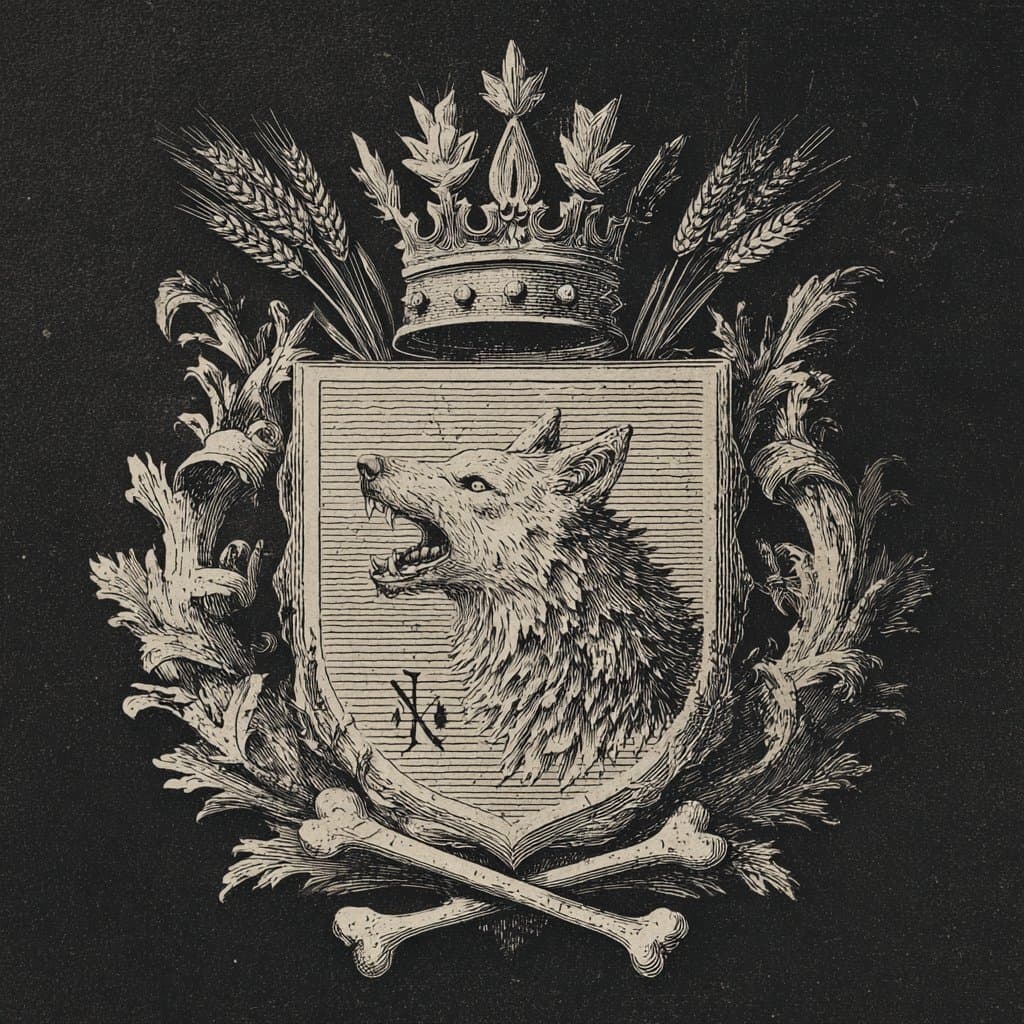
Džačovský
Šariš, Slovakia · b. c. 1870
Andrew was born around the late autumn of 1870, in the Šariš countryside north of Prešov — a world of rye fields, beech forests, and wolves on the high ridges. For years his parents were known only from his 1915 Wisconsin death certificate, in a clerk’s Americanized hand, as John and Julia. They now have their full names, out of the Šarišské Michaľany register: Ján (Joannes) Džačovský and Julianna Miklosko. They were Slovak Roman Catholics. His languages, in order of use: Slovak at home, Hungarian on paper, Latin in church.
At seventeen he left it.
The crossing — April 1887
The ship was the SS Werra. She sailed from Hamburg, arrived at Castle Garden in New York, and carried a seventeen-year-old boy whose name was written on the manifest as Andras Jacowsky — the first time it appeared in a Western alphabet, and the first time it appeared without its D. A German shipping clerk had heard the sound and rendered it in German phonetic convention. By the time the Werra docked, the paper said Jacowsky. Andrew almost certainly never saw it written down.
He was not alone on the manifest. The lines above and below his were filled with other young men from the same Šariš County — Gregorsky, Ellichalik, Šalaj, Hudak — all headed for the same anthracite coal towns of Pennsylvania. Entire village networks were relocating together.
Hazleton, 1887–1897
He spent six years in Hazleton before Sophia crossed. What he did in those six years is undocumented, but the answer is almost certainly coal — the anthracite mines of Luzerne County were the reason Šariš men came, and they were where Šariš men went. On 8 April 1893, at St. Gabriel’s Roman Catholic Church in Hazleton, Andrew married Sophia Barbara Tresch. Marriage license no. 13,136, Luzerne County, witnesses Michael Cornish and a Maria whose surname has not survived the handwriting.
Their children came fast. John in 1894, Mary in 1895, Andrew Peter in 1897. Sophia was twenty-one that September when the Lattimer Massacre killed nineteen unarmed striking miners three miles from their home — mostly Slovak, Polish, and Lithuanian men. She was nursing a newborn.
Ohio, Chicago, Wisconsin
They did not stay. By 1900 the family was in Ohio, where Stephen was born. By 1903 they were in Chicago, where twins Valentine and Michael arrived. Sometime before 1915 they made the final migration northward to Linwood, Wisconsin, in the lake country of Portage County — far from the coal, close to farmland.
Andrew died there on 2 July 1915, aged forty-four. He is buried at Saint Patrick’s Catholic Cemetery in Lanark, Portage County — a long way from the Carpathian beech forests.
The wife
Sophia Barbara
Žofia Barbara Tresch
Prešov, Šariš · Slovakia
5 May 1933 · Stevens Point, Wisconsin
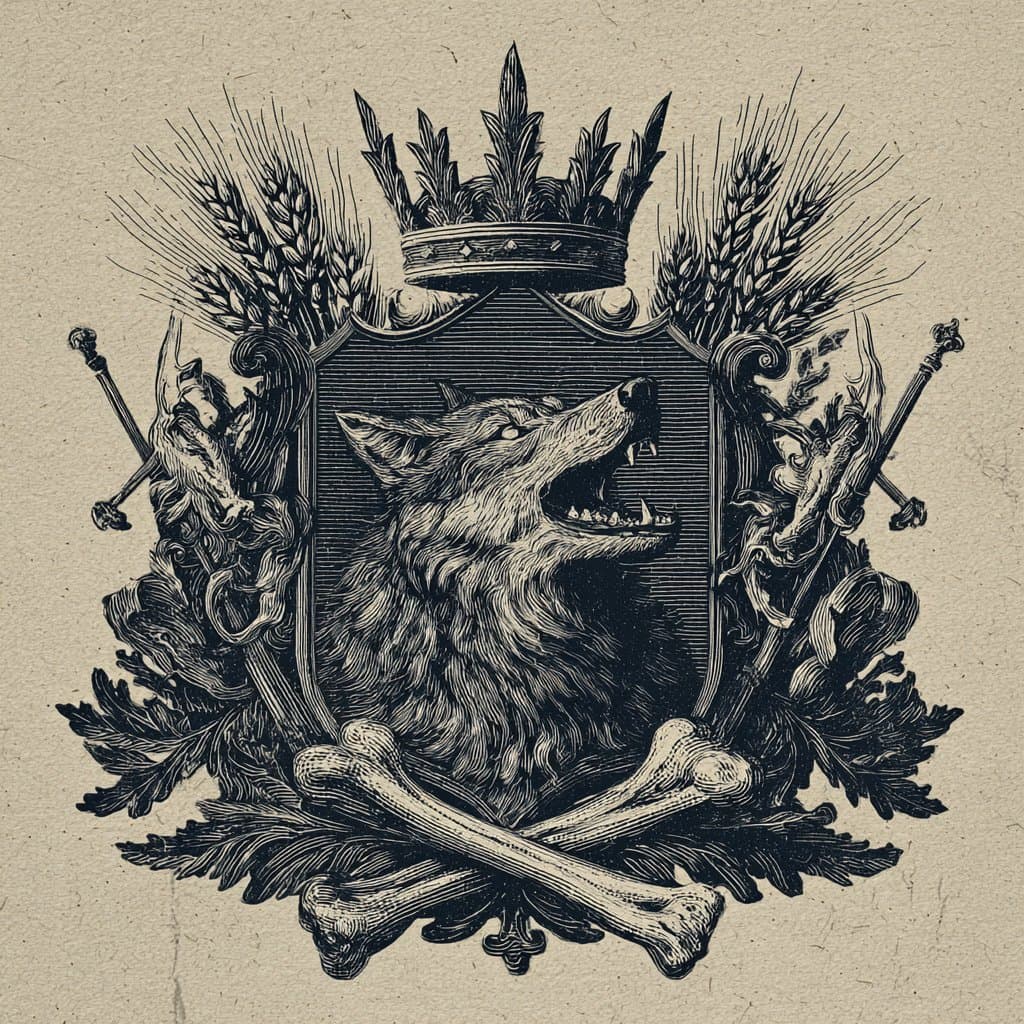
Tresch
Prešov region · Šariš
The one thing a document actually says about Sophia’s origins is spare: her 1933 obituary reports only that she “was born at Prešov, Šarišská county.” That is the whole birthplace statement. A specific village — Šarišská Trstená — and a birth date of 7 May 1876 have circulated in the family research, but neither appears in the obituary and neither has been traced to a source, so both are set aside here until one turns up. One primary record does speak to her age — the couple’s 1893 marriage license — and it only sharpens the puzzle: it gives her birth as May 1871, matching the family’s month but not its year, and records her birthplace merely as “Hungary.” Marriage-license ages ran rough, so it settles nothing — but it is the earliest date anyone wrote down. She was the daughter of John Tresch Sr., who was still living in the old country at the time of her death.
The Tresch surname itself is unusual for the region — Swiss-German in origin, carried into the Carpathians perhaps two centuries before Sophia was born by settlers we cannot yet trace. A 1739 burial entry from the Šariš region records an infant daughter of Joannis Georgÿ Drecsch and his wife Barbarae — the same surname variant, the same region, the same recurring given name that Sophia would carry as her middle name a century and a half later. Whether that is our line remains unproven, but the thread is striking.
She crossed the Atlantic in 1893, the same year Andrew married her in Hazleton. Whether they had been betrothed before he left the old country, or whether the match was made through the tight kinship network of Šariš emigrants already settled in Hazleton, we do not know.
Stevens Point Journal · Saturday, 6 May 1933
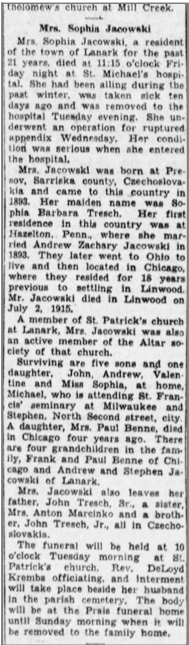
“Mrs. Sophia Jacowski, a resident of the town of Lanark for the past 21 years, died at 11:15 o’clock Friday night at St. Michael’s Hospital. She had been ailing during the past winter, was taken sick ten days ago, and underwent an operation for ruptured appendix Wednesday.
Mrs. Jacowski was born at Prešov, Šarišská county, Czechoslovakia and came to this country in 1893. Her maiden name was Sophia Barbara Tresch…”
The obituary lists five sons and one daughter surviving her, and one daughter — Mrs. Paul Benne — who had died in Chicago four years earlier. It also names the kin she had left behind in the old country, all still living in 1933: her father John Tresch Sr., her sister Mrs. Anton Marcinko, and her brother John Tresch Jr.Interment was at St. Patrick’s, beside Andrew.
The next generation
Seven Children, Three States
The geography of Andrew and Sophia’s children reads like a migration route. Three born in Hazleton. One in Ohio. Three in Chicago. Each birthplace marks where the family was trying to make a living that year.
- 1
John J.
26 April 1894Hazleton, Pennsylvania
First child. Later married Edwina M. Krueger.
- 2
Mary
5 October 1895Hazleton, Pennsylvania
Married Paul Benne, 1912. Died Chicago, 1928. Buried Holy Sepulchre, Alsip IL.
- 3
Andrew Peter
3 May 1897Hazleton, Pennsylvania
Lattimer Massacre year. WWI draft registration in Portage County WI, 1918.
- 4
Stephen
1900Ohio
The Ohio child. Born during the family's brief stay between Pennsylvania and Chicago.
- 5
Valentine R.
1903Chicago
Twin with Michael.
- 6
Rev. Michael
1903Chicago
Twin with Valentine. Ordained Roman Catholic priest, 1935. Served at Holy Rosary Parish, Kewaunee, Wisconsin. Buried there.
- 7
Sophia L.
1913Chicago
Youngest. Later Thompson.
Section Three
The Evidence
Everything below is a primary source — a register page, a manifest, a certificate, a clipping. Each is a piece of paper that survived three centuries of weather, war, redrawn borders, and at least one Atlantic crossing. They are the spine of every claim made elsewhere on this site.
30 May 1756
Baptism of Joannes, son of Martinus Dzjacovsky
Latin baptismal register, folio 151 · Šarišské Michaľany R.C. parish · FamilySearch film 004407849
Scan pending
Joannes — son of Martinus Dzjacovsky and Anna. Godparents: Stephanus Brydos, Eva Mikulasova. Szent Mihály.
The earliest confirmed appearance of the family surname. The register was kept by Father Bonaventura, OFM Conv., chaplain to Count Thomas Szirmay the Younger. Martinus reappears ten weeks later as godfather to a Sapara child — the priest spelled the surname two different ways on the same page, both clearly opening with Dz-.
3–4 December 1875
Baptism of Andreas, son of Andreas Dzákovszky
Hungarian baptism register, entry 115 · Sabinov R.C. parish, house no. 267 · FamilySearch ark:/61903/1:1:V1QJ-417
Scan pending
Andreas Dzákovszky and his wife Barbara Focefcsik baptize a son also named Andreas — the child died at three, in 1878. Because Andrew Zachary’s father is taken to be a Ján, this Andreas of Sabinov is not Andrew’s father; the exact relationship, if any, is unproven. The value of the entry is the house number — 267 — and the confirmation that the surname was rooted in Sabinov well before 1875.
April 1887
Andreas Jacowsky on the SS Werra
Ship manifest · Hamburg → Castle Garden, New York · FamilySearch ark:/61903/1:1:QVPF-VGMB
Scan pending
Andrew’s first appearance in Western paperwork. A seventeen-year-old farm boy from Šariš County, traveling on the German shipping line Norddeutscher Lloyd. The German clerk who wrote his name had no convention for the Slovak Dž- and rendered it as J-. The lines above and below his are filled with other Šariš men headed for the same Pennsylvania coal towns.
8 April 1893
Marriage of Andrew Jakofski and Zofia Trisco
Marriage license docket, No. 13136 · Clerk of Orphans’ Court, Luzerne County PA · License No. 13136
Scan pending
No. 13136. Andrew Jakofski, born in Hungary, residing at Harwood, occupation miner. Zofia Trisco, born in Hungary, residing at Harwood. Marriage license issued 4 Apr. 1893. “Married Apr. 8, 1893 by Rev. C. Fitzmaurice at Hazleton.”
The Luzerne County license docket — the primary record of the marriage. It names the groom “Andrew Jakofski” and the bride “Zofia Trisco” (Tresch), both “born in Hungary” (the political-subject label Slovaks carried) and both living in the mining patch of Harwood; Andrew’s occupation is given as miner. The ceremony was performed at Hazleton by Rev. C. Fitzmaurice — priest of St. Gabriel’s, the town’s Irish territorial parish, used by Slovak couples because their own St. Joseph’s had not yet built a permanent church. The self-reported birth years read as roughly 1872 for Andrew and 16 May 1871 for Sophia; marriage-license ages of this era are often approximate, but this is the earliest document to give Sophia a birth date at all — and it places it in May.
26 April 1894
Baptism of John J. Djacovsky
Slovak parish register, page 35 · St. Joseph’s R.C. Church, Hazleton PA
Scan pending
First child of Andrew and Sophia. Father recorded as “Andrei Djacovsky,” mother as “Zofia Trisch” — a Slovak priest writing the surname phonetically rather than in any Hungarian or English convention.
5 October 1895
Baptism of Mary
Slovak parish register, page 44 · St. Joseph’s R.C. Church, Hazleton PA
Scan pending
Father recorded here as “Andreas Djacimovsky.” A different priest, a different ear, the same sound. Mary later married Paul Benne in Chicago and died there in 1928.
3 May 1897
Baptism of Andrew Peter
Slovak parish register, page 54 · St. Joseph’s R.C. Church, Hazleton PA
Scan pending
Father recorded as “Joannes Djacovsky” — a clerk error: it should be Andreas. Andrew Peter was born in the Lattimer Massacre summer of 1897; he later registered for the WWI draft in Portage County, Wisconsin.
21 January 1912
Marriage of Mary Jacowski and Paul Benne
Civil marriage record · Cook County, Illinois · FamilySearch ark:/61903/1:1:QVMN-PK8S
Scan pending
Mary, Andrew and Sophia’s second child, marries Paul Benne in Chicago. Her parents are recorded as “Andrej Jacovsky” and “Sofia Tresch.” The witness, Zuzanna Handžak, carries a Greek Catholic surname — the kind that turns up across the mixed Slovak and Rusyn borderland of eastern Šariš the emigrants came from.
2 July 1915
Death certificate — Andrew Zachary Jacowski
Wisconsin state death certificate · Portage County Register of Deeds
Scan pending
Andrew dies at forty-four in Linwood Township, Wisconsin. The certificate is the one document that names his parents — recorded by a Wisconsin clerk in Americanized form as John and Julia, the Ján and Júlia of the old country. It is an American record, not a Slovak one: it gives the names, but no Slovak register has yet been found to confirm them. Received April 2026; field-by-field transcription pending the upload of a scan.
September 1928
Death certificate — Mary (Jacowski) Benne
Illinois state death certificate · Cook County · FamilySearch ark:/61903/1:1:N3WT-JSL
Scan pending
Mary dies in Chicago, four years before her mother, and is buried at Holy Sepulchre Cemetery in Alsip. The certificate names her father as “Andrew Jacowski,” birthplace “St. Michael, Slovakia” — the English translation of Šarišské Michaľany.
6 May 1933
Sophia’s obituary
Newspaper obituary · Stevens Point Journal
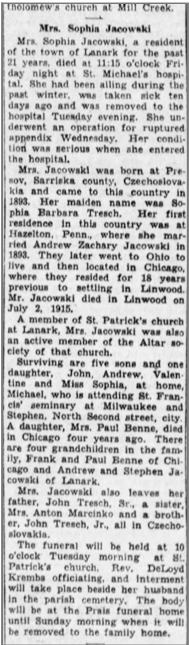
Sophia dies at St. Michael’s Hospital of a ruptured appendix. The obituary is the only document that locates her birth precisely as “Prešov, Šarišská county, Czechoslovakia,” and confirms her father John Tresch Sr. was still alive in the old country in 1933.
Work in progress
The Archive Mailbag
This is a working project, not a finished one. Five archives, four countries, and a handful of outstanding requests. Everything below is either waiting for a response or already delivered.
Štátny archív v Prešove
PhDr. Ferdinand Uličný
ferdinand.ulicny@minv.sk
The archive approved searches of the 18th-century Šarišské Michaľany registers, but could not at first find Andrew's 1870 birth record from the identifiers given — a search-spelling problem, since resolved. The latest reply, 27 July 2026 from Mgr. Veronika Havadejová, reports three things: Juraj Džačovský b. 1888 identified, with an extract available; Mária b. 1890 not identified; and Andrej b. 1870 identified, though that entry carries no place-of-birth field. The archive notes it does not comment on genealogical connections. Outgoing now: a request for the Andrej 1870 and Juraj 1888 extracts, each to include the parents' names with the mother's maiden name, the parish, and the house number. The Andrej extract's mother field should read Julianna Miklosko — that is the confirmation the whole search turns on.
Magyar Nemzeti Levéltár, Budapest
titkarsag@mnl.gov.hu
A drafted inquiry to the Hungarian National Archives, scoped to non-ecclesiastical records only — the parish registers are held in Prešov, not Budapest. It asks about the 1715 and 1720 conscriptions, the 1828 Regnicolaris census for Sáros County, and possible Szirmay estate records, now for Kis-Szeben (Sabinov) as well as Szent-Mihály. The realistic prize is confirming a head of household existed in the village, not parent-child links.
Portage County Register of Deeds
Cynthia A. Wisinski
registerofdeeds@co.portage.wi.gov
Andrew Zachary Jacowski's 1915 Wisconsin death certificate, received April 2026. Names his parents — in the clerk's Americanized rendering — as John and Julia: the Latin Joannes and Julianna of the parish registers.
Wisconsin Vital Records
dhsvitalrecords@wisconsin.gov
Parallel request for the same 1915 death certificate. Satisfied by the Portage County response.
Diocese of Green Bay Archives
archives@gbdioc.org
Clergy file for Rev. Michael Jacowski (b. 1903, ordained 1935, Holy Rosary Parish Kewaunee). The diocese has returned the records it holds.
NEPA Genealogical Society
Sara Klinges
nepgsmail@gmail.com
Hazleton parish and civil records — marriage license, St. Gabriel's Latin register, and all three St. Joseph's baptism records for John, Mary, and Andrew Peter. Surname in every Hazleton parish record: Djacovsky.
The honest inventory
What Remains Unknown
Seven open questions, in the order they matter most. Each is a door we can see but have not yet been able to open.
Open question 01
Andrew's own baptismal line — and his house number
His parents are now confirmed, but the specific 1870 entry reading "Andreas, son of Joannes Dsacsovszky and Julianna Miklosko" has still not been cleanly read, and one near-miss is already caught. The date may itself be wrong — 11 November 1870 comes from American records only — which would put him on an adjacent leaf or in a neighbouring parish. The Prešov archive has located an Andrej 1870 record and an extract is pending; its parents field is the authoritative test.
Open question 02
Ján's own parents — are the grandparents Stephanus and Maria Kriesova?
The highest-value question now open, and the one that would extend the direct line back toward the 1770s. The Gyagyovszky household of Šarišské Michaľany fits — same surname, same village, right generation — but fitting is not proof. Either Ján's own baptism, around 1835 to 1843, or the Ján × Julianna Miklosko marriage of about 1860 would name his parents and decide it.
Open question 03
How Juraj (1888) of Sabinov connects, if at all
The Prešov archive has identified a Juraj Džačovský born 17 April 1888 and an extract is available; a Mária born 16 February 1890 could not be identified. Their father's name is the test of whether the modern Sabinov family ties back to Andrew's household in Šarišské Michaľany. With Sabinov now retired as the family seat, this is a question about relatives rather than about origins.
Open question 04
The gap between the 1770s and Ján — now narrowing
Between the eighteenth-century households of the 1756 and 1770s registers and the birth of Andrew's father lay roughly sixty untraced years. The Gyagyovszky spelling has begun to fill it — households appear back into the 1820s, and burials into the 1700s. What is still missing is the join: the baptisms that connect the 1860s Šarišské Michaľany cluster upward to the Stephanus of the 1770s.
Open question 05
The root of the name
The village of Ďačov is the leading candidate, on the strength of one same-language, document-to-document match — the 1773 village spelling Diačžow against the Džačovský carved on the family's gravestones. It is not proof, and the section above says why. What would decide it is a register entry giving a person's surname and a stated place of origin together.
Open question 06
Where "Šarišská Trstená" and "7 May 1876" came from
Both have circulated for Sophia, and neither appears in the only document that speaks to her origins — her 1933 obituary, which says only "born at Prešov, Šarišská county." Until each is traced to a real source, they float. Her own baptism, wherever it is, would supply the truth.
Open question 07
Why the family left in the first place
Coal, probably. Debt, probably. Chain migration from Šariš to Hazleton was in full flow by the late 1880s, and seventeen-year-old farm boys were the first wave. But nothing specific to Andrew's motivation has survived.
Džačovský
That is the name we came from.